
A renovation
in the Monferrato region

This residence is situated on the outskirts of a small town in the heart of Monferrato. The building, comprising a single dwelling, dates back to the 1800s.
It is constructed of load-bearing masonry and brick vaults.
Although the property enjoys a privileged location, the rooms had small windows and the spaces were cramped and confined. One of the main objectives of the renovation was to re-establish a connection with the landscape and
eliminate small intermediate spaces and favor open spaces.
The renovation was complete, from the consolidation of some structures to the repainting of plaster and systems, and the design of individual custom furnishings.

Il locale rappresentato in queste foto è la cucina/sala da pranzo open-space, precedentemente occupato da due locali più disimpegno. In questo spazio, oltre all'eliminazione di tramezzatura interna, si è aperta una
window and the roof of a previous woodshed was removed, creating a terrace communicating with the dining room.


The image below shows the terrace adjoining the kitchen, which was created by removing the roof of the former woodshed. We chose to preserve a trace of its former self by leaving the original slope visible at the sides, which widens the view towards the landscape.

The room below the kitchen is the living room. This space, which was previously divided into two rooms, has been converted into a single large room. It is designed to be more conducive to relaxation than the previous layout. It is a highly symmetrical room, as are the windows, which are small and mirrored.
As in the previous space, the original vaulted ceilings have been restored, creating a particularly striking effect. The French herringbone-laid oak parquet adds character and atmosphere to the room.


The diagrams below illustrate a problem that has been solved with a bespoke piece of furniture or structure. The rooms in the home are predominantly open-plan, and the hallway/landing is the element that connects them all.


We therefore chose to design an element that would begin at the bottom and rise, unifying the spaces. This element is made of calendered sheet metal, cut to size and painted. It begins as a parapet with a sculptural and sinuous shape and ends with a bookcase in the last hallway of the sleeping area. It is composed of interlocking sheet metal elements, assembled on site.


The image above shows a close-up of the junction between the parapet and the bookcase, which is formed from a single sheet of metal that has been cut and folded.


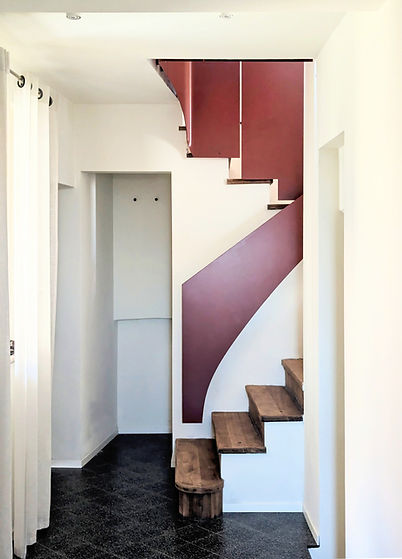
Nell'immagine soprastante l'inizio del sistema parapetto-libreria.
A sinistra la fine della libreria, la quale fa poi da parapetto per la zona notte in cima alla scala.

Below the sleeping area's bathroom, which takes full advantage of the home's restored structure. The wall above the bathtub creates a dramatic backdrop that completes and closes the space.


We tried to create unity between the taps, the coverings and the lighting while maintaining a strong, material style that contrasts with the clean lines of the walls and the bathroom fixtures.


Infine la progettazione del locale bagno di servizio. Il carattere conferito a questo spazio sta nell'accostamento materico tra il rivestimento, la rubinetteria e il parquet creando armonia tra unità e contrasto


The final stage of the design process was devoted to the parquet flooring, which aims to enhance the character of the various rooms and follows their geometric patterns.